This is something to think about. Is it legal to read a book in a bookstore without buying it and then leave? And if not, why is it okay to read that same book in a Library without checking it out and then leave?
Here's a fun comic about this.
Wednesday, July 25, 2007


Tuesday, July 24, 2007
Creative Commons
Creative Commons provides free tools that let authors, scientists, artists, and educators easily mark their creative work with the freedoms they want it to carry. You can use CC to change your copyright terms from "All Rights Reserved" to "Some Rights Reserved."
We're a nonprofit organization. Everything we do — including the software we create — is free.
I haven't tried it but I hear (and read) good things about it. I don't know much about online copyright and how rights and usage in the real world translate to the interwebtubes but this could prove helpful to someone.
For me it's interesting because I'm seriously considering releasing a novel I've been working on online in it's entirety so maybe a Creative Commons "Some Rights Reserved" license is just what I'd need.
Scribd
What is Scribd?
Scribd lets you publish and discover documents online. It is like a big online library where anyone can upload. We make use of a custom Flash document viewer that lets you display documents right in your Web browser. There are all sorts of other features that make it easy and fun to publish, convert, embed, analyze, and read documents.
Part of the idea behind Scribd is that everyone has a lot of documents sitting around on their computers that only they can read. With Scribd we hope to unlock this information by putting it on the web.
It's an interesting idea but it's already pockmarked with seemingly unimportant documents and images. I think it's a great idea in concept but without moderation it's poorly executed. There are already a few clearly illegal documents and copyrighted works even entire novels. However, given time, I think Scribd could be something useful.
What's neat is that Scribd is kinda like Youtube for documents in that each document is it's own file and they're converted into flash so viewing them is 99% possible by everyone since Flash is pretty much ubiquitous. Plus they allow embedding, direct URL links and downloading of documents in several different formats.
One thing I'm not sure about is if you can keep some documents private. I'm not sure how that would fit into their revenue plan and it's not mentioned in their FAQ but if you could keep documents private then Scribd would be even more useful to small companies and individuals to an extent.
If you have a book in print, you can upload an excerpt (or even the whole thing!) to Scribd as a promotion.
Really, it's a place to host your documents for free and view them in any web browser. I like that idea. Since we talk about writing fiction here, here is a link to files tagged with "Novel" at Scribd. And here are the collected works of Poe which is of questionable legality I'm sure.
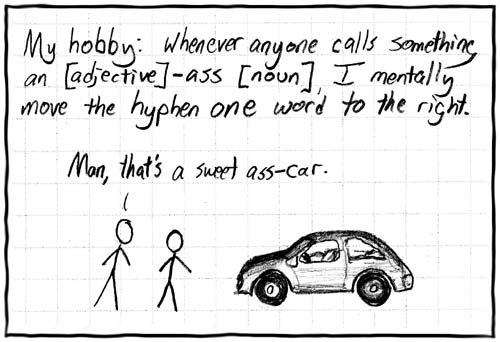
This is a fun one I found on there.
The Humor of Hyphens
Saturday, July 21, 2007
Online Dictionaries Redux
So I've become a bit obsessed with online dictionaries as of late and decided to run an Online Dictionary Showdown which really isn't as hard as it sounds. I picked four words:
encyclicals
monitories
poshlost
chattel
What's great is that there is a one stop shop for most online dictionaries...onelook.com.
Here's how they did:
encyclicals = 2 dictionaries had it.
encyclical, however has 22.
monitories = 1 dictionary.
poshlost = 1 dictionary, at Worthless Word of the Day, no less.
chattel = 21 in general and 13 in business categories respectively.
The winner in this impromptu test? Dictionary.com...gah.
encyclicals
monitories
poshlost
chattel
What's great is that there is a one stop shop for most online dictionaries...onelook.com.
Here's how they did:
encyclicals = 2 dictionaries had it.
encyclical, however has 22.
monitories = 1 dictionary.
poshlost = 1 dictionary, at Worthless Word of the Day, no less.
chattel = 21 in general and 13 in business categories respectively.
The winner in this impromptu test? Dictionary.com...gah.
Online Text Tools
I thought this should get a separate post because it covers several different things, but this page, has several fun online tools relating to words, text, readability and so on.
Anything from intentionally misspelling your text, to analyzing your text for word usage, readability or complexity, to finding how rare or unusual the words are in a text (or suggesting them).
Anything from intentionally misspelling your text, to analyzing your text for word usage, readability or complexity, to finding how rare or unusual the words are in a text (or suggesting them).
Flesch-Kincaid Readability Test
While I'm talking about words, especially unknown ones, here's a way to gauge how difficult a text supposedly is. The Flesch-Kincaid Readability Test.
It's pretty much the de facto standard for measuring a texts readability and what grade level it's written for. The scales are a little hard to conceptualize (for me) at first because for the Ease of Reading metric, the HIGHER the number the easier something is said to be to read. That seems backwards to me, but...that's me.
If you have the inclination it's fun to measure your own work and see where it stands. There are some automated tools online to do this but I have no idea how accurate they (or any of this) really is.
Btw this is the score for the text above this line:
Number of characters (without spaces) : 539.00
Number of words : 123.00
Number of sentences : 8.00
Average number of characters per word : 4.38
Average number of syllables per word : 1.49
Average number of words per sentence: 15.38
Indication of the number of years of formal education that a person requires in order to easily understand the text on the first reading
Gunning Fog index : 9.40
Approximate representation of the U.S. grade level needed to comprehend the text :
Coleman Liau index : 8.06
Flesh Kincaid Grade level : 7.96
ARI (Automated Readability Index) : 6.90
SMOG : 9.71
Flesch Reading Ease : 65.36
List of sentences which we suggest you should consider to rewrite to improve readability of the text :
The scales are a little hard to conceptualize (for me) at first because for the Ease of Reading metric, the HIGHER the number the easier something is said to be to read.
There are some automated tools online to do this but I have no idea how accurate they (or any of this) really is.
I was just thinking that this would be VERY FUN to do to people's emails to see at what level they write at on average...hmmm
Another version of the test is here.
It's pretty much the de facto standard for measuring a texts readability and what grade level it's written for. The scales are a little hard to conceptualize (for me) at first because for the Ease of Reading metric, the HIGHER the number the easier something is said to be to read. That seems backwards to me, but...that's me.
If you have the inclination it's fun to measure your own work and see where it stands. There are some automated tools online to do this but I have no idea how accurate they (or any of this) really is.
Btw this is the score for the text above this line:
Number of characters (without spaces) : 539.00
Number of words : 123.00
Number of sentences : 8.00
Average number of characters per word : 4.38
Average number of syllables per word : 1.49
Average number of words per sentence: 15.38
Indication of the number of years of formal education that a person requires in order to easily understand the text on the first reading
Gunning Fog index : 9.40
Approximate representation of the U.S. grade level needed to comprehend the text :
Coleman Liau index : 8.06
Flesh Kincaid Grade level : 7.96
ARI (Automated Readability Index) : 6.90
SMOG : 9.71
Flesch Reading Ease : 65.36
List of sentences which we suggest you should consider to rewrite to improve readability of the text :
The scales are a little hard to conceptualize (for me) at first because for the Ease of Reading metric, the HIGHER the number the easier something is said to be to read.
There are some automated tools online to do this but I have no idea how accurate they (or any of this) really is.
I was just thinking that this would be VERY FUN to do to people's emails to see at what level they write at on average...hmmm
Another version of the test is here.
Unknown Words While Reading
I've had this problem for a long time now, ever since I've started reading actually. How to handle words in the text that I don't know. I've tried different things:
Looking them up immediately
Making a list for each chapter and looking them up afterwards
Ignoring them and just flag the page to go back to later
The trouble is I don't like looking up words while I'm reading because it's a hassle and I'm lazy like that. I can get myself to make a list while I read but then I'm looking up the words out of context. Ignoring them and thinking I'm going to get back to them later never works. So what to do?
Overall, probably the best solution is to look them up as I read but that's not always convenient because sometimes I'm reading outside, or in bed or sitting in some room someplace or riding in a car...it's just not convenient to lug around a dictionary. I guess an iPhone would be good for this, then I could access ninjawords or something (btw, ninjawords isn't as comprehensive as dictionary.com or others so far. Unfortunately, dictionary.com has a 100% success rate for me while the other online dictionaries I've tried at best get 99% from me...gah).
I have a HUGE dictionary here on my desk. HUGE. I've had it for a while now and while it's not completely up to date with the latest words like I dunno, blog, woot and ZOMG! it's overall fairly comprehensive. I've been making tick marks next to words I've looked up over the years so when I end up looking them up again I know I should be familiar with it. That's why I dig ninjawords history list so much. In a more perfect world dictionary.com would have a history list.
So I'm open for ideas. I'm thinking the best solution (until I get an iPhone or something) is to look up words right then and there or if I can't for some reason, jot down the word on the bookmark I'm using in the book and look them up later. What words don't I know you say? Here's a small selection from my current list:
Splenetic
Encyclicals
Monitories
Scabious
Missal
Lees
Santonin
Nasturtium
Antiphony
Dalmatic
Faille
Samovar
Looking them up immediately
Making a list for each chapter and looking them up afterwards
Ignoring them and just flag the page to go back to later
The trouble is I don't like looking up words while I'm reading because it's a hassle and I'm lazy like that. I can get myself to make a list while I read but then I'm looking up the words out of context. Ignoring them and thinking I'm going to get back to them later never works. So what to do?
Overall, probably the best solution is to look them up as I read but that's not always convenient because sometimes I'm reading outside, or in bed or sitting in some room someplace or riding in a car...it's just not convenient to lug around a dictionary. I guess an iPhone would be good for this, then I could access ninjawords or something (btw, ninjawords isn't as comprehensive as dictionary.com or others so far. Unfortunately, dictionary.com has a 100% success rate for me while the other online dictionaries I've tried at best get 99% from me...gah).
I have a HUGE dictionary here on my desk. HUGE. I've had it for a while now and while it's not completely up to date with the latest words like I dunno, blog, woot and ZOMG! it's overall fairly comprehensive. I've been making tick marks next to words I've looked up over the years so when I end up looking them up again I know I should be familiar with it. That's why I dig ninjawords history list so much. In a more perfect world dictionary.com would have a history list.
So I'm open for ideas. I'm thinking the best solution (until I get an iPhone or something) is to look up words right then and there or if I can't for some reason, jot down the word on the bookmark I'm using in the book and look them up later. What words don't I know you say? Here's a small selection from my current list:
Splenetic
Encyclicals
Monitories
Scabious
Missal
Lees
Santonin
Nasturtium
Antiphony
Dalmatic
Faille
Samovar
Friday, July 20, 2007
The Wilmarth Cafe
I've never "been there" but it seems like a decent enough place. What's interesting though is that their website has nearly all the works of H.P. Lovecraft (apparently, not sure, his works are in the public domain now) and they have some interactive fiction in the vein of Choose Your Own Adventure books.
Author Podcasts
This is pretty cool. Book Expo America has podcast interviews with authors. Since I'm largely -nearly exclusively actually- interested in fiction, here's the page with podcast interviews with authors of fiction.
I haven't had time to listen to too much but I think it's worth bookmarking and maybe even subscribing to. Of course I have to promote a podcast of one of my favorite fun (and by fun I mean it's basically light reading) authors F. Paul Wilson the creator of Repairman Jack.
(btw, it looks like there's going to be a Repairman Jack film soon. I'm not sure how I feel about this as Hollywood seems quite adept at turning good things into bad on a regular basis and they seem to love not only words like "remake" and "re-imagining" but "franchise" as well. Gah.)
I haven't had time to listen to too much but I think it's worth bookmarking and maybe even subscribing to. Of course I have to promote a podcast of one of my favorite fun (and by fun I mean it's basically light reading) authors F. Paul Wilson the creator of Repairman Jack.
(btw, it looks like there's going to be a Repairman Jack film soon. I'm not sure how I feel about this as Hollywood seems quite adept at turning good things into bad on a regular basis and they seem to love not only words like "remake" and "re-imagining" but "franchise" as well. Gah.)
Books Which No Longer Exist
On the opposite end of the field from non-existent books lugubriously lay books that never existed.
Probably the largest collection of texts that no longer exist is the Library of Alexandria's collection of knowledge. Destroyed largely due to religious intolerance and ignorance only a few fragments remain as well as a few titles of forever lost scrolls. These will likely never be recovered.
Les Journées de Florbelle and other works by the Marquis de Sade. Upon his death the Marquis de Sade requested that much of his work be destroyed. Unhappily some were. Again, there's little chance this will ever be recovered.
Ernest Hemingway lost, literally, an entire suitcase full of his writings. It's debated exactly what was contained in the suitcase be it original or carbon copies and from what period in his life they came from, but nevertheless, they're now lost. There is the chance that somewhere this suitcase or portions of it's contents are still floating around either misplaced in someone's attic, exchanged quietly between private collectors or buried somewhere deep in a landfill.
Louisa May Alcott's Long-Lost Novel was found unexpectedly.
Capote's lost novel was recently discovered.
And then there are the individuals such as Maurice Girodias who have produced false novels, purporting to be actual books that are only fictions themselves within a novel.
Bizarrely enough, this "fake" novel of The Seven Minutes (retitled 7 Erotic Minutes) is still available.
Probably the largest collection of texts that no longer exist is the Library of Alexandria's collection of knowledge. Destroyed largely due to religious intolerance and ignorance only a few fragments remain as well as a few titles of forever lost scrolls. These will likely never be recovered.
Les Journées de Florbelle and other works by the Marquis de Sade. Upon his death the Marquis de Sade requested that much of his work be destroyed. Unhappily some were. Again, there's little chance this will ever be recovered.
Ernest Hemingway lost, literally, an entire suitcase full of his writings. It's debated exactly what was contained in the suitcase be it original or carbon copies and from what period in his life they came from, but nevertheless, they're now lost. There is the chance that somewhere this suitcase or portions of it's contents are still floating around either misplaced in someone's attic, exchanged quietly between private collectors or buried somewhere deep in a landfill.
Louisa May Alcott's Long-Lost Novel was found unexpectedly.
Capote's lost novel was recently discovered.
And then there are the individuals such as Maurice Girodias who have produced false novels, purporting to be actual books that are only fictions themselves within a novel.
He also got into serious trouble with Simon & Schuster and author Irving Wallace over a book called "The Original Seven Minutes" by JJ Jadway which purported the be the actual book featured in Irving Wallace's title The Seven Minutes.
Bizarrely enough, this "fake" novel of The Seven Minutes (retitled 7 Erotic Minutes) is still available.
Wednesday, July 18, 2007
Jennifer Weiner's Advice
Jennifer Weiner is an author of chick-lit or book club books or something. I'm not sure. I've never read any of her novels but she does have a page with some good advice for those wanting to write and get published. Here's a sample:
Not all of it applies to everyone but it's worth a read.
I sold my first story to Seventeen magazine - one of the shrinking number of mass-market magazines that still publishes fiction. No agent. I just printed up my story, wrote a cover letter saying who I was and what I'd done, and mailed it off, and was thrilled and delighted a few months later when I got a phone call….and, eventually, a check.
Now, granted, I went to Fancypants U., and I was able to do some name-dropping on my cover letter. Did that help? Sure, probably it did. Is it necessary? I don't think so. I think if I'd submitted the same short story (it was called "Tour of Duty," and published in the spring of 1992), with a letter that left out all the stuff about Princeton, and just said I was a recent college graduate working as a reporter, the story would have met with the same happy response. No matter where, or whether, you went to college, good writing finds a home.
Not all of it applies to everyone but it's worth a read.
Detective Sheep Novels
Her novel, just released in the United States, is a detective story with a twist. Shepherd George Glenn is discovered murdered in a sheep pasture, with a spade in his chest, but the humans are helpless so some talking sheep come into play to solve the crime.
Not only is the idea not what you expected but the author is already working on a sequel and a film is already in the works. Full story here.
The amazon link is here.
What's interesting to me is that the novel is largely told from the sheep's perspective. It's not hard to be reminded of Animal Farm or myriad other stories about animals like Charlotte's Web but that humans are observed by the animals is something I'd like to see more of.
Here's the description of Three Bags Full:
In this refreshingly original detective story from debut German author Swann, a flock of sheep investigates the murder of their beloved shepherd, George Glenn. Leading the effort is Miss Maple, considered the cleverest sheep in the Irish seaside village of Glennkill. She slyly "pretends" to graze while eavesdropping on suspects who come to search George's caravan for something he may have died for. When a long-lost ram recounts an incident that occurred upon his departure years earlier, Miss Maple uncovers the catalyst for George's death. The wooly troupe reveals the crime's solution in a near-Shakespearean mime at the annual "Smartest Sheep in Glennkill" contest. The author's sheep's-eye view and the animals' literal translation of the strange words and deeds of the human species not only create laugh-out-loud humor but also allow the animals occasional flashes of accidental brilliance.
I'm also reminded of Jean George's Frightful's Mountain wish is told from the perspective of a falcon.
Non-Existent Books
Some books should never have been written, and some, never were.
I like the old phrase, "Some books were never meant to be written" myself.
Here are two links to lists of non-existent books:
Best Non-Existent Books
Answers.com list of non-existent books.
And here's another good list.
I like the old phrase, "Some books were never meant to be written" myself.
Here are two links to lists of non-existent books:
Best Non-Existent Books
Answers.com list of non-existent books.
And here's another good list.
The Book of the Book
Idries Shah's The Book of the Book is a fairly well known, well, book.
From this wiki page:
I've flipped through this book online, and may even order it just to A, have a copy and B, see what it's all about but aside from that this has reminded me of another, similar book:
This is A Perfect Vacuum by Stanislaw Lem, circa 1971.
There is also mention of a book entitled Investigations of the Writings of Herbert Quaine by Jorge Luis Borges but I can't find mention of it at his wiki page and very little else other than this page.
Either way this has started me thinking, not so much about the "antinovel" but really what's possible with experimental novels. Nothing experimental and/or different just for the sake of being different, mind you, but more along the lines of Experimental and False Histories.
I have some notes on it and I think it would run the gamut from alarmingly simple to nearly impossibly difficult to write. I may give it a go though. I have a title for it, translated into Latin to sound even more mysterious, but I'll hang onto that for now. It's not terribly original meaning that there are some books around like this, but not many and there hasn't been one with a cohesiveness to it as far as I've seen similar to my idea.
From this wiki page:
Author Idries Shah, distrusting critics' reviews of his books, wrote The Book of the Book (1969, ISBN 0-900860-12-X), which consists of sixteen written pages of reviews of itself. The rest of the book is intentionally filled with about 140 blank pages to give the appearance of a normal book. Initial reactions were generally negative, but over time critics have come to praise it.
I've flipped through this book online, and may even order it just to A, have a copy and B, see what it's all about but aside from that this has reminded me of another, similar book:
It is an anthology of imaginary reviews of nonexistent books. some of the reviews remind the reader of drafts of his science-fiction novels, some read like philosophical pieces across scientific topics, from cosmology to the pervasiveness of computers, finally others satirise and parody everything from the nouveau roman to pornography, Ulysses, authorless writing, and Dostoevsky.
This is A Perfect Vacuum by Stanislaw Lem, circa 1971.
There is also mention of a book entitled Investigations of the Writings of Herbert Quaine by Jorge Luis Borges but I can't find mention of it at his wiki page and very little else other than this page.
Either way this has started me thinking, not so much about the "antinovel" but really what's possible with experimental novels. Nothing experimental and/or different just for the sake of being different, mind you, but more along the lines of Experimental and False Histories.
I have some notes on it and I think it would run the gamut from alarmingly simple to nearly impossibly difficult to write. I may give it a go though. I have a title for it, translated into Latin to sound even more mysterious, but I'll hang onto that for now. It's not terribly original meaning that there are some books around like this, but not many and there hasn't been one with a cohesiveness to it as far as I've seen similar to my idea.
Subscribe to:
Posts (Atom)
